For years, New York State has served as the epicenter of the Merchant Cash Advance (MCA) industry. Because traditional banks can turn away small-to-medium-sized businesses (SMBs) due to strict credit requirements or lack of collateral, MCA funders can step in to provide quick liquidity.
While these alternative financing instruments serve a critical function in the economy, they are uniquely structured. Typically, they are set up as a purchase of future receivables at a discount, rather than issuing a standard loan. Historically, this has allowed them to operate outside of traditional banking regulations. This lack of oversight led to confusing contracts, assertive collection tactics, and systemic cash flow challenges for thousands of businesses.
However, the legal landscape in New York is rapidly shifting in favor of the business owner. As we briefly touched on in our general Merchant Cash Advance Regulation Guide, state legislatures are taking decisive action in regards to high-cost commercial debt. If your business is located in New York, or if your company is managed from within the state, you are now within the circle of some of the most stringent commercial finance laws in the nation.
Here is the ultimate, all-encompassing guide to understanding Merchant Cash Advance rules in New York, the groundbreaking disclosure laws you must know, and the sweeping legislative changes on the horizon for 2026.
Coastal Debt Resolve is not a law firm, and these materials are provided for informational purposes only and do not constitute legal, financial, or professional advice.
1. The New York Commercial Finance Disclosure Law (CFDL)
Before 2023, an MCA funder operating in New York could issue a contract using "factor rates" rather than Annual Percentage Rates (APRs). Because factor rates do not account for the velocity of repayment, business owners found it nearly impossible to calculate the true annualized cost of the capital they were accepting.
To bridge this transparency gap, New York enacted the Commercial Finance Disclosure Law (CFDL), which officially took effect on August 1, 2023.
The CFDL requires certain commercial lenders and MCA funders that provide financing of $2.5 million or less to present a standardized disclosure document to a potential recipient at the exact time an offer is extended. This law mandates consumer-style, Truth-in-Lending-Act (TILA) disclosures for commercial transactions.
If you are offered an MCA in New York today, the funder is legally required to disclose:
- The Estimated Annual Percentage Rate (APR): Funders must state an APR when quoting a specific finance charge or financing amount.
- The Total Finance Charge: The final rules require that the total finance charge, including underwriting and origination fees typically charged by the funder, must be clearly calculated and disclosed.
- Broker Compensation: If a broker is involved in the transaction, the MCA funder must inform the business in writing of exactly how and by whom the broker is being compensated.
- The Total Disbursement Amount: Exactly how much cash will actually land in your operating account after all upfront fees are deducted.
Who Does the CFDL Apply To? The CFDL is highly targeted. It applies to transactions where the recipient's business is principally directed or managed from the state of New York, or if the recipient is a resident of New York. While it covers most fintech companies and online commercial lending platforms, it does carve out exemptions for traditional financial institutions, such as federally or state-chartered banks and credit unions.
2. Usury Caps vs. "True Sales" of Receivables
One of the most complex elements of New York Merchant Cash Advance laws is how these instruments interact with the state's usury limits.
In New York, it is a felony to charge more than 25% interest on a loan, establishing a strict criminal usury cap to prevent predatory lending. So, how do MCA funders legally charge effective rates that often exceed 100% APR?
They do this by structuring the transaction as a "purchase of future receivables" rather than a loan. By successfully arguing that the transaction is not technically a "loan," MCA providers have historically secured carve-outs from New York's strong usury laws.
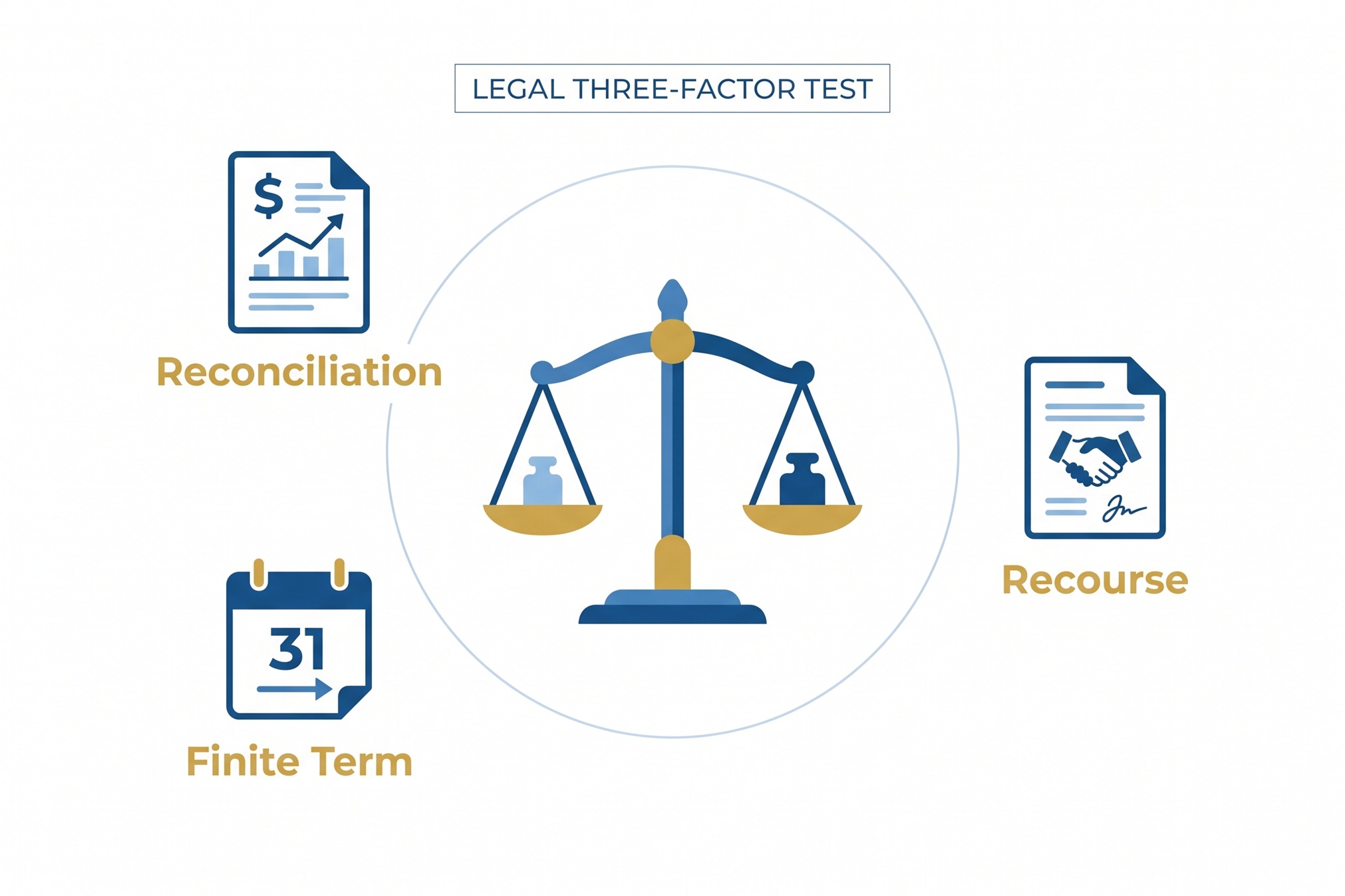
To determine if an MCA is a legally valid purchase of receivables or an illegally disguised loan violating the 25% cap, New York courts typically apply a highly scrutinized three-factor test:
- Reconciliation: Does the contract allow the merchant to reconcile (adjust) their daily payment amounts if their actual business revenue drops?
- Finite Term: Is there an absolute, fixed timeline for repayment (a hallmark of a loan), or is the timeline contingent entirely on the business's ability to generate future sales?
- Recourse: If the business goes bankrupt and fails to generate future receivables, does the funder still have absolute recourse to pursue the owner personally for the remaining balance?
If a New York court determines that an MCA contract fails this test and operates exactly like a loan, the contract can be deemed criminally usurious and voided entirely.
3. The 2025-2026 Legislative Push: Closing the Loophole
The legal distinction between a loan and a cash advance is currently facing an existential threat in the New York State Legislature. Lawmakers have introduced aggressive new bills during the 2025-2026 legislative session aimed at closing the loopholes that allow MCA funders to bypass the 25% usury cap.
Senate Bill S1726 (The End Loan Sharking Act) Introduced for the 2025 to 2026 term, Senate Bill S1726 (dubbed "ELSA") proposes to extend New York's usury laws to cover all "financing arrangements," purposefully broadening the definition to capture Merchant Cash Advances. To stop funders from masking their costs, S1726 clarifies that "interest" must include all finance charges, fees, and expenses. If passed, it would effectively make it illegal to charge more than 25% interest on an MCA in New York.
Senate Bill S10127 Similarly, Senate Bill S10127, introduced in the 2025-2026 session, specifically seeks to extend New York's criminal usury framework to "covered services". The bill explicitly defines covered services to include merchant cash advances, revenue-based financing, and any transaction that functions as an advance of funds in exchange for a future payment.
While neither bill has been signed into law at the time of this writing, their introduction clearly signals that New York lawmakers are actively moving to regulate MCA pricing structures heavily.
4. The End of the Confession of Judgment (COJ)
No guide to New York Merchant Cash Advance rules would be complete without discussing the Confession of Judgment (COJ).

Historically, New York was the preferred state for MCA funders because of its unique laws regarding COJs. A Confession of Judgment is a legal document signed by a business owner at the time of funding, in which they admit liability and agree to the entry of a judgment against them without a trial. For years, MCA funders would require out-of-state business owners to sign a New York COJ. If the business missed a payment, some funders would file the COJ with a New York county clerk, in an attempt to freeze the business's operating accounts, even if the business was located in Texas or Florida.
Recognizing this use of the legal mechanism, New York completely amended its laws to ban this practice. Today, a New York court will no longer accept the filing of a Confession of Judgment against an out-of-state debtor. If an MCA funder wants to pursue legal action against a non-New York resident, they must now do so through traditional, localized litigation, stripping away one of the strongest and immediate collection tools in the commercial finance industry.
Navigating MCA Debt with Coastal Debt Resolve
The regulatory environment for Merchant Cash Advances in New York is quickly pivoting toward transparency and putting businesses first. Laws like the CFDL ensure that you have the right to understand exactly what you are paying before you sign, and the ban on out-of-state COJs has significantly leveled the playing field for business owners nationwide.
However, transparency laws only help you before you take the capital. If you are already stuck in a cycle of high-frequency daily MCA withdrawals that are negatively affecting your operating cash, knowing the law is only the first step. You need a strategic exit plan.
If your New York business (or a business managed from New York) is struggling with unmanageable MCA debt, commercial debt settlement is often the most effective path forward.
At Coastal Debt Resolve, our professional negotiators deeply understand the nuances of New York Merchant Cash Advance laws. We work with you to negotiate reduced balances, convert daily ACH withdrawals into manageable payment schedules, and preserve your company's revenue streams.
You do not have to navigate the complex world of commercial debt alone. Contact Coastal Debt Resolve today at (888) 707-7177 for a free, confidential consultation. Let our team review your contracts and help you take back control of your business.